


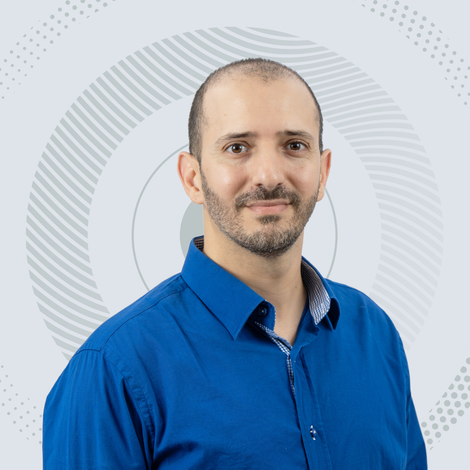
Dr. Yishay Pinto
Genomics, Microbiology, Bacteriophages, Human gut virome, AI, Large Language Models in genomics, Metagenomics.
Research
The Pinto Lab: Bacteriophages, Bacteria and Us
Our Mission
The human microbiome is often studied through a bacterial-centric lens, yet the human virome, particularly bacteriophages (phages), plays a crucial, underexplored role in our health. The Pinto Lab shifts this paradigm by exploring the microbiome through a unique "Triad" perspective: investigating the complex interactions between bacteriophages, their bacterial hosts, and the human host.
Our Strength: Computational Innovation & Metagenomics
Culturing human phages remains a significant challenge, so we rely on advanced sequencing-based methods as our primary lens. Our lab specializes in metagenomics and computational profiling, utilizing tools like Phanta to accurately identify phages and their specific bacterial hosts within complex human samples.
We define the cutting edge of phage biology by integrating these genomic profiles with Large Language Models (LLMs) to predict phage functions and host compatibilities, allowing us to decode viral genomes with unprecedented depth.
Key Research Questions
1. Phage-Bacteria Interactions & Human Health
We aim to move beyond static snapshots to understand the dynamic role of the virome in health and disease
Disease Associations: How do specific phage-bacteria compositions correlate with metabolic disorders and autoimmune conditions?
Virome Dynamics: Is there a "core" virome shared across healthy humans, and how stable are these viral communities over time?
2. Triggers of Prophage Activation
Prophages (viral DNA integrated into bacteria) can remain dormant for long periods. We want to know what "wakes them up":
Induction Triggers: How do host signals and external factors like antibiotics and dietinduce dormant phages to switch to an active, lytic state?
Microbiome Reshaping: How does this activation disrupt the bacterial community and influence the stability of the microbiome?
3. Direct Phage Interactions with Human Systems
Phages do not just interact with bacteria; they interact with us.
Immune Recognition: Which phage epitopes are recognized by the human immune system, and how does this shape our immunity?
Direct Crosstalk: Do phages mimic human proteins to evade detection, and can they translocate from the gut to circulate in the bloodstream?
Impact
By characterizing these interactions, the Pinto Lab aims to establish a comprehensive framework for the human virome. Our goal is to leverage phages as biomarkers and precision tools to modulate the microbiome, paving the way for novel diagnostic and therapeutic strategies.
Publications
Pinto Y. Beyond bacteria: Phanta adds flavour to microbiome profiling with a focus on phages. Nature Reviews Immunology. 25, 159, 2025; https://doi.org/10.1038/s41577-025-01138-5
Pinto Y, Bhatt AS. Sequencing-based analysis of microbiomes. Nature Reviews Genetics. 829–845, 2024; https://doi.org/10.1038/s41576-024-00746-6
Frishman S, Nuriel-Ohayon M, Turjeman S, Pinto Y, Yariv O, Tenenbaum-Gavish K, Peled Y, Poran E, Pardo J, Chen R, Muller E, Borenstein E, Hod M, Louzoun Y, Schwartz B, Hadar E, Collado M. C, Koren, O. Positive effects of diet-induced microbiome modification on GDM in mice following human faecal transfer. Gut. 2024; 73:e17 https://doi.org/10.1136/gutjnl-2023-331456
Pinto Y*, Chakraborty M*, Jain N, Bhatt AS. Phage-inclusive profiling of human gut microbiomes with Phanta. Nature Biotechnology. 42, 651–662, 2023; https://doi.org/10.1038/s41587-023-01799-4
Avizemel O, Frishman S, Pinto Y, Michael Y, Turjeman S, Tenenbaum-Gavish K, Yariv O, Peled Y, Poran E, Pardo J, Chen R, Hod M, Schwartz B, Hadar E, Koren O, Agay-Shay K. Residential greenness, gestational diabetes mellitus (GDM) and microbiome diversity during pregnancy. International Journal of Hygiene and Environmental Health. 2023; 251:114191; https://doi.org/10.1016/j.ijheh.2023.114191
Pinto Y*, Frishman S*, Turjeman S, Eshel A, Nuriel-Ohayon M, Shtossel O, Ziv O, Walters W, Parsonnet J, Ley C, Johnson EL, Kumar K, Schweitzer R, Khatib S, Magzal F, Muller E, Tamir S, Tenenbaum-Gavish K, Rautava S, Salminen S, Isolauri E, Yariv O, Peled Y, Poran E, Pardo J, Chen R, Hod M, Borenstein E, Ley RE, Schwartz B, Louzoun Y, Hadar E, Koren O. Gestational diabetes is driven by microbiota-induced inflammation months before diagnosis. Gut. 2023; 72(5):918-92; https://doi.org/10.1136/gutjnl-2022-328406
Highlighted in Diagnostics World (https://tinyurl.com/GDMdiag)
Picked up by 11 news outlets (https://bmj.altmetric.com/details/141055848/news)
Babin BM, Keller LJ, Pinto Y, Li VL, Eneim AS, Vance SE, Terrell SM, Bhatt AS, Long JZ, Bogyo M.; Identification of covalent inhibitors that disrupt M. tuberculosis growth by targeting multiple serine hydrolases involved in lipid metabolism. Cell Chemical Biology. 2022; 29(5):897-909; https://doi.org/10.1016/j.chembiol.2021.08.013
Levin D*, Raab N*, Pinto Y*, Rothschild D*, Zanir G, Godneva A, Mellul N, Futorian D, Gal D, Zeevi D, Bachelet I, Segal E. Diversity and functional landscapes in the microbiota of animals in the wild. Science. 2021; 372(6539); https://doi.org/10.1126/science.abb5352
Highlighted by Lind & Pollard, Science, 2021. (10.1126/science.abg9095)
Picked up by 15 news outlets (https://science.altmetric.com/details/102765556/news)
Ben-Haim MS*, Pinto Y*, Moshitch-Moshkovitz S, Hershkovitz V, Kol N, Diamant-Levi T, Schnaider Beeri M, Amariglio N, Cohen HY, G, Rechavi G. N6,2′-O-dimethyladenosine (m6Am) Regulates High Fat Western Diet Induced Obesity. Nature Communications. 2021; 12(1):7185; https://doi.org/10.1038/s41467-021-27421-2
Stehlikova Z, Kostovcik M, Kostovcikova K, Kverka M, Juzlova K, Rob F, Hercogova J, Bohac P, Pinto Y, Uzan A, Koren O, Tlaskalova-Hogenova H, Jiraskova Zakostelska Z; Dysbiosis of skin microbiota in psoriatic patients: co-occurrence of fungal and bacterial communities. Frontiers in Microbiology. 2019; https://doi.org/10.3389/fmicb.2019.00438
Pinto Y, Levanon EY. Computational approaches for detection and quantification of A-to-I RNA-editing. Methods. 2019; 156:25-31; https://doi.org/10.1016/j.ymeth.2018.11.011
Pinto Y, Buchumenski I, Levanon EY, Eisenberg E. Human cancer tissues exhibit reduced A-to-I editing of miRNAs coupled with elevated editing of their targets. Nucleic Acids Research. 2018; 46(1):71-82; https://doi.org/10.1093/nar/gkx1176
Pinto Y*, Gabay O*, Arbiza L, Sams AJ, Keinan A, Levanon EY. Clustered mutations in hominid genome evolution are consistent with APOBEC3G enzymatic activity. Genome Research. 2016; 26(5):579-587; https://doi.org/10.1101/gr.199240.115
Highlighted in Science (10.1126/science.aaf4097)
Picked up by 11 news outlets.
Sapoznik S, Bahar-Shany K, Brand H, Pinto Y, Gabay O, Glick-Saar E, Dor C, Zadok O, Barshack I, Zundelevich A, Gal-Yam EN, Yung Y, Hourvitz A, Korach J, Beiner M, Jacob J, Levanon EY, Barak M, Aviel-Ronen S, Levanon K. Activation-induced cytidine deaminase links ovulation-induced inflammation and serous carcinogenesis. Neoplasia. 2016; 18(2):90-99; https://doi.org/10.1016/j.neo.2015.12.003
Shamay-Ramot A, Khermesh K, Porath HT, Barak M, Pinto Y, Wachtel C, Zilberberg A, Lerer-Goldshtein T, Efroni S, Levanon EY, Appelbaum L. Fmrp interacts with adar and regulates RNA editing, synaptic density and locomotor activity in zebrafish. PLoS Genetics. 2015; 11(12):e1005702; https://doi.org/10.1371/journal.pgen.1005702
Geula S, Moshitch-Moshkovitz S, Dominissini D, Mansour AA, Kol N, Salmon-Divon M, Hershkovitz V, Peer E, Mor N, Manor YS, Ben-Haim MS, Eyal E, Yunger S, Pinto Y, Jaitin DA, Viukov S, Rais Y, Krupalnik V, Chomsky E, Zerbib M, Maza I, Rechavi Y, Massarwa R, Hanna S, Amit I, Levanon EY, Amariglio N, Stern-Ginossar N, Novershtern N, Rechavi G, Hanna JH. m6A mRNA methylation facilitates resolution of naïve pluripotency toward differentiation. Science. 2015 ;347:1002-1006; https://doi.org/10.1126/science.1261417
Pinto Y, Cohen HY, Levanon EY. Mammalian conserved ADAR targets comprise only a small fragment of the human editosome. Genome Biology, 2014; 15(1):R5; https://doi.org/10.1186/gb-2014-15-1-r5
Zlitni S, Bowden S, Sberro H, Torres MDT, Vaughan JM, Pinto AFM, Pinto Y, Fernandez D, Röst H, Saghatelian A, de la Fuente-Nunez C, Bhatt AS. Dual quorum-sensing control of purine biosynthesis drives pathogenic fitness of Enterococcus faecalis. bioRxiv [Preprint]. 2024 Aug 13:2024.08.13.607696. https://doi.org/10.1101/2024.08.13.607696
Camargo AP, Baltoumas FA, Ndela EO, Fiamenghi MB, Merrill BD, Carter MM, Pinto Y, Chakraborty M, Andreeva A, Ghiotto G, Shaw J, Proal AD, Sonnenburg JL, Bhatt AS, Roux S, Pavlopoulos GA, Nayfach S, Kyrpides NC. A genomic atlas of the human gut virome elucidates genetic factors shaping host interactions. bioRxiv. 2025 https://doi.org/10.1101/2025.11.01.686033
Finkelstein, S., Frishman, S., Turjeman, S., Shtossel, O., Riumin, A., Tikhonov, E., Nuriel-Ohayon M, Pinto Y, Popova P, Tkachuk AS, Vasukova EA, Anopova AD, Pustozerov EA, T Pervunina T, Grineva EG, Hod M, Schwartz B, Hadar E, Koren O, Louzoun, Y. (2025). Nutrition-dependent development of the Oral Microbiome in Early Pregnancy. bioRxiv, 2025. https://doi.org/10.1101/2025.09.29.679276
Google scholar profile: https://scholar.google.com/citations?user=nYRQiRMAAAAJ
Last Updated Date : 27/04/2026